Tuesday, April 10, 2018

Foundations : Women Empowerment

http://www.sevenbarfoundation.org/

Google Search Org. Subtitle:

The Seven Bar Foundation is a 501(c)3 non-profit organization with a business model for social impact, empowering women around the world.

Key Quotes_Homepage:

"Seven Bar Foundation empowers women via microfinance by helping them out of poverty and into business."

Key Quotes_About Us/How We Work Page: 
http://www.sevenbarfoundation.org/about-us/how-we-work/
  
"To prevent poverty by teaching a trade, setting up a person in business, or in some other way preventing the need of charity."
– Maimonides, 1135-1204

"The micro-loans allow women around the world to start or maintain their own small businesses." 

Key Quotes_About Us/Chariwomans Profile
http://www.sevenbarfoundation.org/about-us/chairwomans-profile/

"Observing first-hand the limits of traditional charity and having witnessed the transformative force of microfinance through her program in India, Black developed a business model for social impact, establishing The Seven Bar Foundation as the brand for the Empowerment of Women to fund microfinance institutions on a consistent and global basis. By mainstreaming the “ladder” icon, the Foundation has signed cause-marketing campaigns with Fusion Beauty, Royal Asscher, Kraft Foods, and Diageo, yielding nearly half a million in proceeds and impacting 2,350 women locally and globally."

Saturday, January 3, 2015

Wake up, Stanford.

"Change comes slowly in the academy, but someone here said the other day that the way to herd cats is to move the cat food."
--Jennifer Summit, professor of English at Stanford

Primary claims:

Stanford is making changes in their curriculum to encourage humanities doctoral students to graduate in five years (rather than 7-9 years) by focusing classes on student interests and research, holding students accountable by evaluating their progress, and supporting and celebrating all student achievement. Is this a joke? What has Stanford been doing as an educational institution up until this point?

Article URL: https://www.insidehighered.com/news/2012/12/04/stanford-moves-ahead-plans-radically-change-humanities-doctoral-education


Tuesday, December 4, 2012

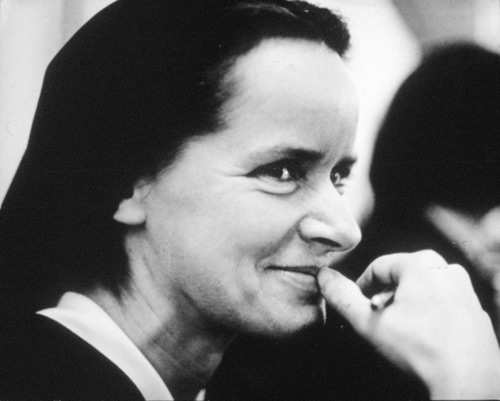
Sister Corita Kent


A catholic convent might not be the first place to consider when searching for a radical art education in the late 20th century - that is, unless you had Sister Corita Kent as an instructor. Aside from creating over 400 brilliantly colored serigraphs radical in their manipulation of text, graphic design elements, and activism, Corita Kent was an inspiring and influential educator to both teachers and students alike. In this beautiful documentary created by Araron Rose, we are given a glimpse into Kent’s unconventional instruction through first hand accounts made by her students and peers. Here we see how her radical teaching methods stimulate her students' creativity beyond the classroom by teaching them first and foremost “how to see, to really see,...to look, to look again - anew.” 
 
http://www.nowness.com/day/2010/6/5/685/breaking-a-habit-sister-corita

A clip from the documentary, Become a Microscope by Aaron Rose

As part of a project in 1967-1968, Kent authored “Ten Rules,” a list of “commandments” for both the student and teacher participating in a creative practice. These rules were later appropriated permanently by the Immaculate Heart Convent art department - at which she had been both an alumni and a sister - and have been adopted and popularized by artist and educator John Cage, who is directly quoted as the tenth rule. The rules are as follows:


RULE ONE: Find a place you trust, and then try trusting it for awhile.


RULE TWO: General duties of a student — pull everything out of your teacher; pull everything out of your fellow students.


RULE THREE: General duties of a teacher — pull everything out of your students.


RULE FOUR: Consider everything an experiment.


RULE FIVE: Be self-disciplined — this means finding someone wise or smart and choosing to follow them. To be disciplined is to follow in a good way. To be self-disciplined is to follow in a better way.


RULE SIX: Nothing is a mistake. There’s no win and no fail, there’s only make.


RULE SEVEN: The only rule is work. If you work it will lead to something. It’s the people who do all of the work all of the time who eventually catch on to things.


RULE EIGHT: Don’t try to create and analyze at the same time. They’re different processes.


RULE NINE: Be happy whenever you can manage it. Enjoy yourself. It’s lighter than you think.


RULE TEN: “We’re breaking all the rules. Even our own rules. And how do we do that? By leaving plenty of room for X quantities.” (John Cage)


HINTS: Always be around. Come or go to everything. Always go to classes. Read anything you can get your hands on. Look at movies carefully, often. Save everything — it might come in handy later.


Corita Kent was both an alumni and sister of LA’s Immaculate Heart Convent. She ran the art department from 1951 until 1968 when she moved to Boston. Corita Kent died of cancer Sept. 18, 1986. Find more information about Sister Corita Kent and her extraordinary life at https://www.corita.org/.

------

"Breaking A Habit: Sister Corita." NOWNESS. N.p., 5 June 2010. Web. 03 Dec. 2012. <http://www.nowness.com/day/2010/6/5/685/breaking-a-habit-sister-corita>.

Papova, Mario. "Brain Pickings." Brain Pickings RSS. N.p., 10 Aug. 12. Web. 03 Dec. 2012. <http://www.brainpickings.org/index.php/2012/08/10/10-rules-for-students-and-teachers-john-cage-corita-kent/>.

"Corita Kent." Corita Art Center--Art and Activism of Sister Mary Corita. N.p., n.d. Web. 03 Dec. 2012. <https://www.corita.org/>.

Tuesday, November 27, 2012

Artist Placement Group - (APG)

What a brilliant idea!

This is all preliminary research pertaining to the Artist Placement Group.
                                                                                                                                                      

E-Flux

"Artist Placement Group, APG." E-flux. N.p., n.d. Web. 27 Nov. 2012. <http://e-flux.com/timebank/event/artist-placement-group-apg>.

Note: This appears to be a press release for an exhibition, The Social Contract, 14 Feb - 23 Feb 2012

http://e-flux.com/timebank/event/artist-placement-group-apg

"Artist Placement Group (APG) was conceived by Barbara Steveni in London in 1965, and established a year later by Steveni and founding artists Barry Flanagan, David Hall, John Latham, Anna Ridley, and Jeffrey Shaw, among others. Between 1966 and the mid-1980s, APG negotiated approximately twenty placements on behalf of artists in industry and government. Unlike most residency schemes that have emerged in its wake, APG artists were not required to produce any determinable object as a result of her or his placement."

The goals of the APG were to:

-place an artist in an industry or government non-art related
-not to have the artist "work for" the industry, but it was more of an experiment to see what might be the benefit/outcome of a creative individual in an typically "non-art" situation

It was very difficult to evaluate the influence on either the artist or industry this program had.  

Artist Placement Group, Between 6, Städtische Kunsthalle Düsseldorf, 1971. Courtesy Barbara Stevini
                                                                                                                                                       

Frieze Magazine
Context is Half the Work
Peter Eleey 
 
Eleey, Peter. "Frieze Magazine | Archive | Context Is Half the Work." Frieze Magazine RSS. N.p., Nov. 2011. Web. 27 Nov. 2012. <http://www.frieze.com/issue/article/context_is_half_the_work/>. 

"In 1966, the Artist Placement Group was founded to integrate artists into businesses and corporations around Britain. Did the strategy bear fruit?"
In the same decade two similar groups developed:
  • Los Angeles County Museum of Art, "Art and Technology Program" under the direction of curator Maurice Tuchman
  • A collaboration between Bell Labs and Robert Rauschenberg, Experiments in Art and Technology (EATS)

"APG favoured the notion that artists could have a positive effect on industry through both their inherent creativity and their relative ignorance of its conventions." 

1968 - Industrial Negative Symposium, London

Artist Placements:

Garth Evans - British Steel Corporation
David Hall - British European Airways + Scottish Television
Stuart Brisley - Hillie Co. Ltd
Leonard Hessing - ICI Fibres
Lois Price - Milton Keynes Development Corporation
Ian MacDonald-Munro + Marie Yates - Centre for the Study of Human Learning at Brunel University
John Latham - National Coal Board + Proteus Bygging
Ian Breakwell + David Parsons - British Rail
Andrew Dipper - Esso Petroleum

APG recieved much criticism as an art practice. 

"Lathom's...'least-event,' an idea borrowed from scientist friends, which he saw as a kind of zero moment from which things flowed forward into the present and beyond."

"Instead of pulling the audience and environment into the art work, APG located the work out in the world, a tabula rasa on which society’s approval of artists (or lack thereof) would register."

In 1989, APG refocused its efforts in advocacy and policy than actual placement and renamed "Organization and Imagination" (O+I).

"Nevertheless, the Utopian vision of what she called ‘repositioning art in the decision-making processes of society’ remained and continues in force."

"The approach of APG makes evident artists’ obsession during the 1960s and ’70s to engage with the new ‘systems’ of social science, culture and industry, but it was among the first to model in its practice the shift towards a service-based economy that was occurring in society at large, as well as the rise of intellectual property as a product."

Other service-based practices referenced in this article:

"When artists work in open-endedly collaborative relationships – projects such as Marjetica Potrc’s infrastructure improvements in impoverished communities, Superflex’s guarana co-operative and soft drink company in Brazil, Thomas Hirschhorn’s Bataille Monument (2002) or France Morin’s The Quiet in the Land residencies"


Raven Row (Contemporary Art Space, London) 

The Individual and the Organisation: Artist Placement Group 1966-79

Curated by Antony Hudek and Alex Sainsbury, consultation by Barbara Steveni

"The Individual and the Organisation: Artist Placement Group 1966-79." Raven Row. Ed. Antony Hudek and Alex Sainsbury. N.p., n.d. Web. 27 Nov. 2012. <http://www.ravenrow.org/current/>.

"APG arranged that artists would work to an 'open brief', whereby their placements were not required to produce tangible results, but that the engagement itself could potentially benefit both host organisations as well as the artists in the long-term."

"Instead of commissioning art works, the host organizations were asked to pay the artist wages and in exchange, they would benefit from the artist's reports, ideas and insights."

Monday, November 19, 2012

Statement

Statement
 
My creative practice is disguised as pedagogical programming that aims to initiate proactive and innovative responses to everyday challenges. By collaborating with communities to develop a network of resources that are accessible and relevant, I explore how creative experiences have sustainable effects. 

Third-person Statement

Gabriela Santiago's creative practice is disguised as pedagogical programming that aims to initiate proactive and innovative responses to everyday challenges. By collaborating with communities to develop a network of resources that are accessible and relevant, Gabriela explores how creative experiences have sustainable effects.

Thursday, November 15, 2012

Turning

Curating the Educational Turn
Turning

Irit Rogoff

Rogoff, Irit. "Turning." Curating and the Educational Turn. Ed. Paul O'Neill and Mick Wilson. London: Open Editions, 2010. 23-31. Print.
   
Found online here: http://www.e-flux.com/journal/turning/

Date: 11/11/2012

Primary claims made in this reading:

This is a powerful article about education. I wish I could add the entire text as a giant quote. Basically, Rogoff is evaluating effective education on two primary principles: potentiality (the possibility to act) and actualisation (understanding that the possibility to act and organise exists everywhere). 

Key Figures: 

A.C.A.D.E.M.Y project (2006) - "a series of exhibitions that took place at the Van Abbemuseum in Eindohoven as a collaboration between 22 participants and museum staff. The project as a whole posed the question: 'What can we learn from the museum?' and referred to learning that operated beyond what the museums sets our to show or teach us." (Pg. 35)

Th
Bologna Declaration - the reform of European education that focuses on standardizing education by standardizing evaluation and outcomes.

Key Quotes: 

"By potentiality, we meant the possibility to act which is not limited to the ability to act. Acting, therefore, can never be understood as something simply enabled by a set of skills or opportunities; it is also dependent on a will and a drive. Even more importantly, it must also include within it an element of fallibility - the possibility that acting will entail failure." (Pg. 36)

"...actualisation, by which we mean understanding that there are meanings and possibilities embedded within objects, situations, actors, and spaces and that it is our task to liberate them, as it were." (Pg. 36)

"These other approaches place education as forever reactively addressing the woes of the world while we hoped to posit education 'in' and 'of' the world, not a s a response to crisis but part of its ongoing complexities, producing realities, not reacting to them, and many of these are low key and un-categorisable and non heroic and certainly not uplifting but nevertheless immensely creative." (Pg. 39) 

"Propelled from within, rather than boxed in from the outside, education becomes the site of odd and unexpected coming together - shared curiosities, shared subjectivities, shared sufferings, shared passions congregate around the promise of a subject, of an insight, of a creative possibility." (Pg. 39)

"At its best, education forms collectivities, many fleeting collectivities which ebb and flow, converge and fall apart. Small ontological communities are propelled by desire and curiosity, cemented together by the kind of empowerment that comes from intellectual challenge." (Pg. 39)

"The point about coming together in curiosity is that we don't then have to come together in identity..."(Pg. 40)

"So, at this moment in which we are so preoccupied with how to participate, how to take part in the limited ground that remains open, education signals rich possibilities of coming together and participating in an arena that is not yet signaled." (Pg. 40)

"Perhaps there is a n excitement in shifting out perception of a training ground to one which is not pure preparation, pure resolution.  Instead, it might encompass fallibility, understand it as a from of knowledge production rather than of disappointment." (Pg. 40) 

"...I want to think of education as all of the places to which we have access. And access, as I understand it, is the ability to formulate one's own questions, as opposed to those that are posed to you in the name of an open and participatory democratic process, for it is clear that those who formulate the questions produce the playing field." (Pg. 41)

"...in education, when we challenge, we are saying there is room for imagining another way of thinking..." (Pg. 41)

concatenate

adjective

linking together.

verb (concatenated, concatenation, concatenating)

to link together in a series or chain 


"Concatenate." About Our Definitions: All Forms of a Word (noun, Verb, Etc.) Are Now Displayed on One Page. Merriam-Webster. Merriam-Webster, n.d. Web. 15 Nov. 2012. <http://www.merriam-webster.com/dictionary/imbrication>.